
Greene Criminal History Checks
Begin a Greene criminal record search with the office that made the item. Police reports remain with Greene Police. A local justice court keeps its own docket, while the county jail controls booking and custody data. New York does not provide a public DCJS name search. WebCrims can help with selected pending matters, but it omits closed cases, sealed files, and warrants. A sound search uses the records in sequence.
- Contact the Village of Greene Police Department for a village incident or arrest report.
- Give the incident date, location, number if known, precise record sought, contact details, and preferred electronic format.
- Check the current Unified Court System court directory, then ask the proper Greene clerk about its docket.
- For current custody, call the Chenango County booking desk at 607-337-1850. Use county court channels if a felony moves onward.
- Use WebCrims for a future appearance or request a fingerprint-based DCJS Personal Record Review for your own statewide record.
Start With Greene Police Reports
A Greene officer's incident or arrest report does not automatically move into a county public-records portal. The municipal agency remains the source. Ask Greene Police how to submit a request under the New York Freedom of Information Law, and name the exact report instead of seeking every record about a person. A narrow request gives staff useful search keys and makes redaction decisions easier.
Describe the incident date, place, report type, and incident number when available. State whether an electronic copy will work and whether certification is needed. The research did not verify a current Greene police records fee, counter schedule, or municipal copy rate, so confirm those points through the official police route before visiting or paying. Police narratives, arrest sheets, dispatch logs, video, and crash reports are distinct items. Request each one by name.
Records at Greene Police
The Village of Greene Police Department creates reports for incidents its officers handle within village jurisdiction. Those files can reflect an initial complaint, officer observations, witness accounts, alleged offenses, and enforcement steps. They do not settle guilt or supply the final result of a case. A later court disposition may differ from the allegation stated at the time of arrest.
No official Greene arrest blotter or standalone criminal case portal was located in the research. That gap makes the department's published contact route important. If State Police made an arrest in the Greene area, Greene Police may have no responsive report. In that case, use the New York State Police FOIL route. Ask which agency owns the incident number before sending duplicate requests.
Records may be redacted when disclosure would invade privacy, expose a confidential source, reveal protected methods, endanger someone, or interfere with an active investigation. Juvenile and youthful-offender material receives separate protection. A partial response is not proof that the omitted facts never existed.
Greene's Rural Court Network
Greene sits within a rural county where town and village justice courts create many arraignment, misdemeanor, violation, traffic, and warrant records. A search limited to County Court in Norwich can miss a local file. This local spread matters more in Chenango County than it would in a one-court city system. First read the court caption and docket number on the ticket, appearance notice, or accusatory paper.
The UCS directory is the best current source for the justice, clerk, address, telephone number, and session details because small-court schedules can change. Call before travel. Ask whether the clerk can confirm a case number, inspection process, copy format, and certification charge. Do not rely on an old directory listing, and do not assume that the village police counter and the court clerk share records merely because both serve Greene.
A docket number is the local court's case key. It is not a police incident number, jail booking number, NYSID, or DOCCS identification number. Give the clerk the number printed under the correct court caption when possible. If only a name is known, add the approximate year and next appearance date rather than asking for an unrestricted history. This helps the Greene clerk distinguish the local matter from a county indictment or a different town-court file.
Booking and Arrest Records in Greene
A Greene arrest can create at least three separate local records. Greene Police creates the incident and arrest report. The local court opens a case at arraignment. If the person is held, Chenango County Corrections creates a booking at its County Road 46 facility in Norwich. Fingerprintable events may also reach DCJS, but a DCJS rap sheet is not open to public name searches.
Chenango County does not publish a verified public jail roster on its normal website. For present custody, call the booking desk at 607-337-1850. The sheriff's official smartphone app also advertises inmate and jail information. For releasable booking material, use the sheriff's published FOIL instructions. The absence of a press release or web result does not prove that no arrest occurred.
Note: A Greene booking charge records the intake allegation, not a conviction or the final charge filed in court.
Greene Report or County Booking
The village report and county booking overlap, but they serve different purposes. The police report tells how the event was reported and what officers did. The jail entry records admission, charge information known at intake, custody status, and release or transfer actions. Neither replaces the justice-court file.
| Greene record | Best source | Main question answered |
|---|---|---|
| Incident or arrest report | Greene Police | What officers reported and what action began the matter |
| Booking or custody entry | Chenango County Sheriff | Whether county intake occurred and what custody status followed |
| Local docket | Correct Greene justice court | What was filed, scheduled, amended, or decided |
| Fingerprint record | DCJS self-review | How the subject's fingerprint-linked New York cycle is recorded |
Use identifiers that fit the system. A police incident number will not necessarily work as a court docket number, and a jail booking number is not a court case number. Matching names alone also carries risk, especially where spelling or dates differ.
The Greene Municipal Court File
Greene village and town justice functions handle locally filed misdemeanors, violations, arraignments, and early felony proceedings within their jurisdiction. A felony may begin on a complaint in a local court before an indictment moves the prosecution to Chenango County Court. Finished local matters do not automatically become County Court files.
| Court caption | Identifies whether the matter belongs to the Greene village or town justice function |
|---|---|
| Case types | Local misdemeanors, violations, traffic matters, arraignments, and preliminary felony steps within jurisdiction |
| Lookup channel | WebCrims for selected future dates, followed by the correct clerk through the UCS directory |
| Docket contents | Case identifier, filed accusations, appearances, pleas, orders, disposition, and sentence when part of the public file |
| Copies and fees | Ask the clerk about inspection, paper or electronic copies, certification, and the current charge |
The court record is the stronger source for the legal result. Charges can be reduced, added, dismissed, or resolved by plea or trial. Obtain the disposition from the clerk before describing an arrest allegation as an outcome.
Closed Greene Cases Need Clerks
WebCrims is useful for selected pending criminal cases and future appearances. It supports name, case-identifier, and calendar searches. It does not provide a full Greene criminal history, closed-case archive, free document store, or warrant list. A blank result can mean the matter is closed, sealed, filed in another local court, too new for display, or entered under a spelling variation.
When WebCrims shows nothing, identify the court from the original paperwork and call that clerk. Provide the full name, approximate year, and docket number if known. Ask whether the file is public, whether it can be inspected, and how to get a certificate of disposition. If a felony was indicted, contact the County or Supreme Court clerk at the Eaton Center in Norwich. The broader Chenango County court case lookup explains that county-level path.
WebCrims name mode calls for at least the first three letters of the last name and first two letters of the first name under the official interface guidance. Case-identifier mode expects the court's number format, while calendar mode turns on the appearance date and court. A Greene jail booking number will not work in the case-number field. When a match appears, treat the displayed name, court, part, next date, and appearance purpose as leads. Ask the clerk for filed papers, a complete disposition, or a certified result.
How Greene Records Reach the County
A Greene case does not move as one bundled file. Police retain their report. The court holds the docket. Chenango Corrections keeps a booking if county custody occurred. Prosecutors decide what accusation proceeds, and court clerks report qualifying dispositions to DCJS. Timing gaps arise because each custodian updates on its own schedule.
Record flow: Greene Police › Greene justice court › Chenango County Court when indicted › New York State Division of Criminal Justice Services
For very recent conduct, start in Greene. For current custody, use the county booking desk. For a final result, return to the court that owns the docket. For your own fingerprint-linked state record, request DCJS Personal Record Review through IdentoGO. A third party cannot order another person's DCJS rap sheet merely to check that person's history.
Greene Warrants Require the Court
WebCrims expressly does not show warrants, and no official Greene warrant-name portal was found. A bench warrant often follows a missed appearance or failure to comply, while an arrest warrant authorizes custody on a charge. The issuing court controls its own status. Sheriff or police records may confirm releasable facts, but an old list cannot show that a warrant was recalled.
If you are checking your own possible Greene warrant, call the issuing court or speak with counsel before arriving at an office. Ask about the correct appearance or surrender process and how to confirm a recall in writing. Do not assume an information visit carries no custody risk. If the issuing court is unknown, start with the court caption on prior papers, then use the UCS directory or the sheriff's general information line at 607-334-2000 option 1.
Greene Records in State Systems
New York's state tools answer narrower questions. OCA Criminal History Record Search is a paid exact-name and date-of-birth court search, not a fingerprint rap sheet. WebCrims is free but limited to selected pending cases and future appearances. DCJS Personal Record Review is the official self-review route and uses fingerprints through IdentoGO. It can help a subject find an arrest cycle with a missing disposition.
The Greene image below comes from the official DOCCS Parolee Lookup. It illustrates a state supervision channel that is separate from Greene Police, the local court, and the county jail.
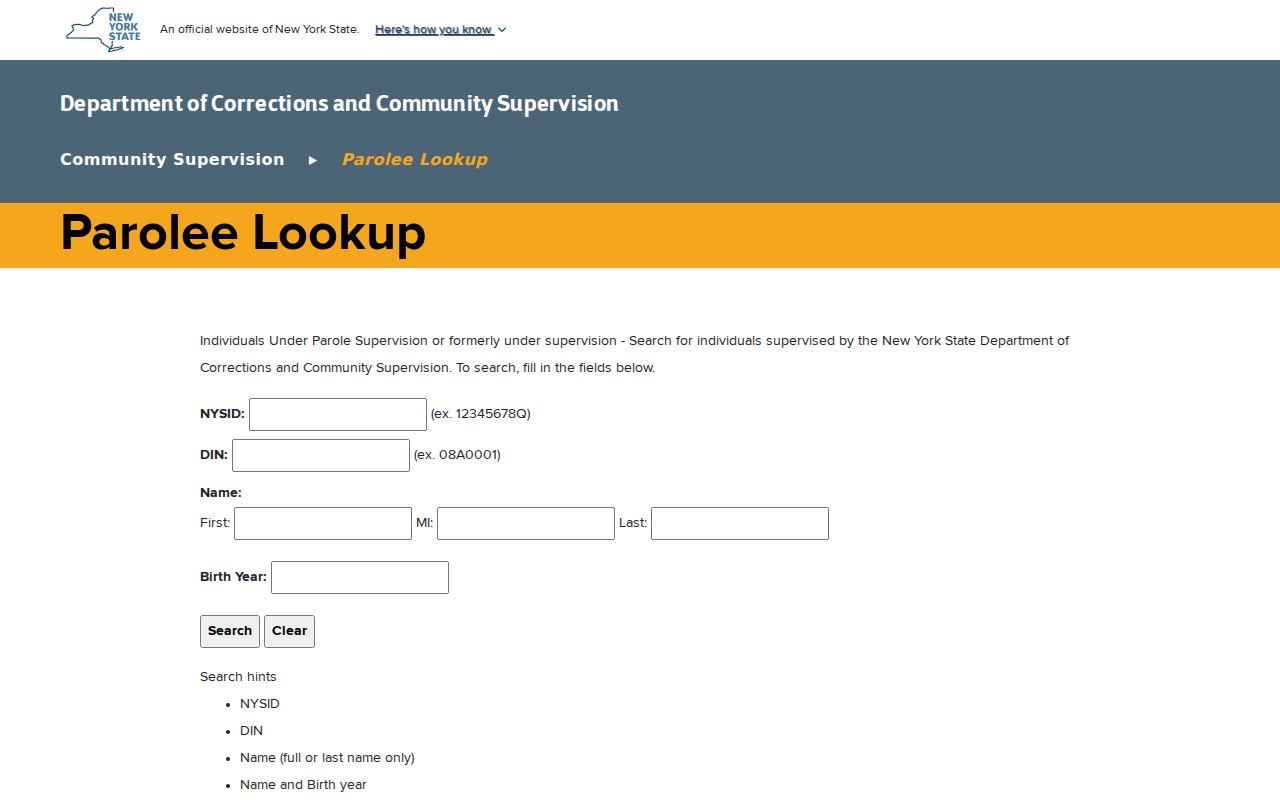
Use that lookup only for state parole or community-supervision information. It does not search Greene incident reports, local warrants, county bookings, or all criminal cases.
Greene Record Access Rules
New York FOIL begins with access to agency records, but it permits specific redactions and withholding. Greene Police may protect active-investigation facts, private identifiers, confidential sources, sensitive methods, or information that could endanger someone. Court access follows court law and clerk procedure. Sealed cases, grand-jury evidence, and youthful-offender records do not become public through a broad request.
Key Statutes:
New York Freedom of Information Law sets the agency-record access, exemption, response, and appeal framework.
Judiciary Law § 255 directs court clerks to search and certify court records upon a lawful request and fee.
CPL 160.50 seals records after a termination favorable to the accused, subject to stated exceptions.
Ask for a written reason and appeal route if an agency denies a FOIL request. When part of a record can be released, redaction may be the proper response instead of withholding the whole item. Verify any allegation against the final court disposition.